
Contents
When the world’s governments gathered in Vienna for the 13th Conference of the Parties to the UN Convention against Transnational Organized Crime (UNTOC COP13), one of the side events put a simple question to delegates: how do you get insiders to report financial crime, and how do countries work together once they do?
The National Whistleblower Center (NWC), who are also members of International Whistleblower Advocates IWA hosted the session, titled Effective Practices for International Cooperation on Anti-Money Laundering and Illegal Offshore Banking.
NWC Program Manager Jeana Lee moderated. The first speaker was Eliza Lockhart, Senior Research Fellow at the Centre for Finance and Security at the Royal United Services Institute (RUSI), a London-based security think tank. Her remarks are summarized below. A companion article covers the second speaker, Kohn, Kohn & Colapinto founding partner and IWA’s chief supervising attorney Stephen M. Kohn.
The research behind the talk
Lockhart is the author of The Inside Track: The Role of Financial Rewards for Whistleblowers in the Fight Against Economic Crime, published in December 2024 as a research paper for the SOC ACE research programme. The paper examines reward programs in the United States and Canada and draws lessons for the UK. RUSI reports that it has since been cited in the UK Anti-Corruption Strategy 2025 and in Jonathan Fisher KC’s Independent Review of Disclosure and Fraud Offences, both in support of financial rewards for economic crime whistleblowers.
Big scandals, one common thread
Lockhart opened with a slide of headlines from some of the largest international banking scandals: the Danske Bank money laundering case, Wirecard, 1MDB, LuxLeaks, and the UBS tax case. Her point was that every one of them came to light because an insider came forward. Danske Bank alone involved roughly €200 billion in suspicious payments moving through its small Estonian branch.
She also asked the audience to remember the human cost. Behind each headline is a person, and in her experience few whistleblowers escape financial, professional, personal, or health consequences. Doing the right thing, she said, often is not enough. Whistleblowers need protection and, in financial crime cases, frequently a financial benefit that reflects what they are risking.
How a reward program works
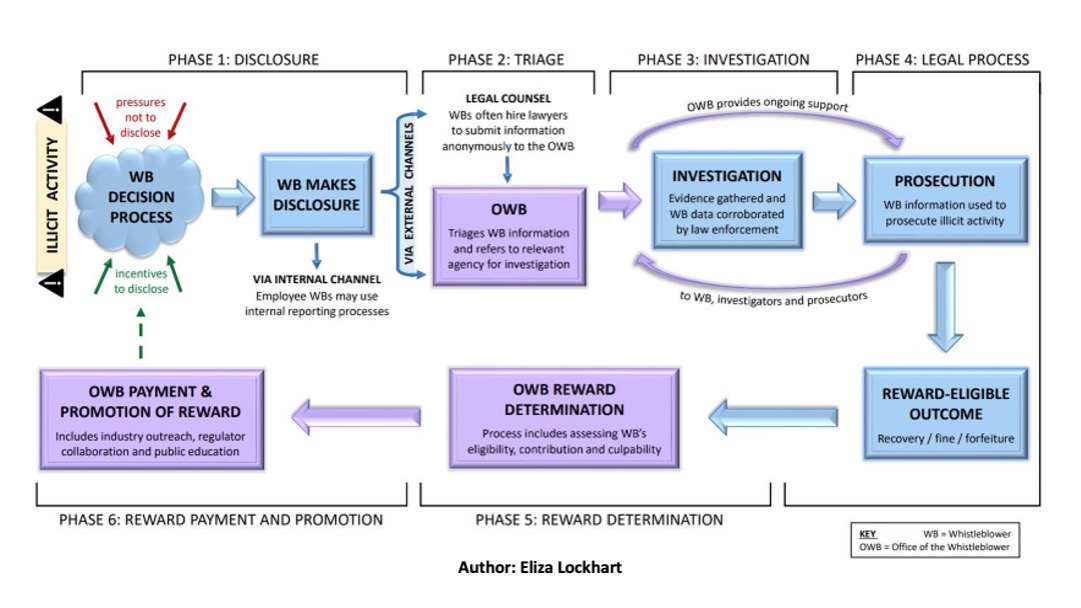
Lockhart walked through a simplified diagram from her paper to clear up common misunderstandings:
- The decision to speak. A whistleblower learns of wrongdoing and faces pressure not to disclose, from the organization, from fear of retaliation, and from concern for their family.
- Internal reporting first. Evidence from existing programs shows most whistleblowers report internally before going outside. They see themselves as employees who found a problem and want it fixed, not as whistleblowers.
- Going external. If the problem is not fixed, the person may go to a regulator or hire a lawyer, who can act on their behalf while they remain anonymous.
- A specialist office. Most regulators running these programs have an Office of the Whistleblower that assesses the tip and decides whether to refer it to law enforcement.
- Investigation and prosecution. Law enforcement corroborates the information and, if warranted, refers the case to prosecutors. The Office of the Whistleblower and the whistleblower’s representative support the case throughout.
- The reward decision. If there is a legal outcome and money is recovered, the regulator weighs factors such as how important and helpful the information was, and reduces the award for things like involvement in the wrongdoing or obstruction. Lockhart noted that most schemes pay somewhere between about 5% and 30% of the recovery.
- The feedback loop. Paying awards and publicizing the program encourages the next whistleblower to come forward.
Four findings
Lockhart concluded with the four findings from her research:
- The programs deliver results. They increase the number of whistleblowers coming forward with actionable intelligence, and that has led to more successful prosecutions and more financial recovery. But rewards do not work in isolation. They need protection, support, and a specialist team that understands how whistleblowing works.
- Consult to customize. She compared program design to Lego building blocks. Countries have many design choices, and the right mix depends on a country’s legal system, existing whistleblower protections, and culture. A program cannot simply be copied from one country to another.
- Prioritize the message, not the messenger. Lockhart called this the most important point. Governments often tell her that people should come forward because it is the right thing to do, and that paying them corrupts the process. In her view, that confuses whistleblowing with a moral act. Law enforcement already pays for and relies on many kinds of intelligence, and whistleblowers should be treated the same way. Because awards are paid only when the information leads to a recovery or a positive law enforcement outcome, she described it as paying for results.
- Monitor and adjust. A program cannot be set up and forgotten. Illicit financial actors keep adapting to exploit gaps, so governments need a process to keep reviewing what is working, amplify the good outcomes, and fix the bad ones.
A changing attitude
Lockhart closed by describing how quickly the debate has moved. When she spoke to UK and Australian regulators while researching her paper, there was still a cultural attitude that paying a whistleblower “just wasn’t done.” Since then, she said, high-profile scandals broken by whistleblowers have shifted public opinion, and jurisdictions that were once firmly against rewards are now looking at how to integrate them into their economic crime strategies.
The UK is a clear example. In November 2025, HM Revenue and Customs launched its Strengthened Reward Scheme, offering 15% to 30% of tax collected in qualifying cases. In October 2026, the UK government said the Serious Fraud Office is developing plans to reward whistleblowers who report economic crimes such as fraud and bribery, following a recommendation in a July 2026 review led by Jonathan Fisher KC.
Why it matters for the UN conversation
The organized crime convention gathers governments to improve how they cooperate against crimes that cross borders. Lockhart’s message to that audience was practical. Financial crime is built to stay hidden, insiders are often the only people who can see it, and the evidence from existing programs suggests that protection, support, and a fair reward can bring them forward. The design choices are up to each country, but the underlying logic applies everywhere.

Joseph Orr
Joseph is an author at IWPA and writes about anti-corruption.